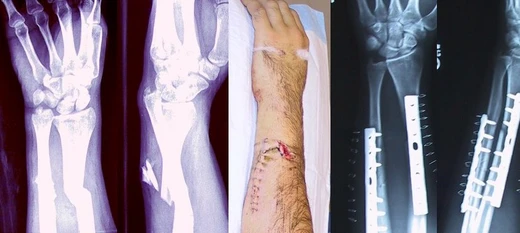
Femoral fracture
A fracture of the femur, often from high-energy trauma.

A femoral fracture is a break in the thigh bone, usually caused by high-energy impacts like car crashes because the femur is very strong. Breaks in the middle section (diaphysis) are treated differently from those at the upper end—the head, neck, and trochanter—which are known as hip fractures. In medical terms, "femoral fracture" typically refers to breaks in the shaft or lower part of the bone.
Signs and symptoms are often obvious due to the high-energy cause. These include swelling, deformity, and a shortened leg. There is frequently extensive soft-tissue damage, bleeding, and shock. The main symptom is severe pain that prevents leg movement.
For diagnosis, a physical exam is important because a femoral shaft fracture can distract from other injuries, such as damage to the same-side knee’s ligaments or meniscus. X-rays are taken from the front (AP) and side (lateral), along with images of the hip, pelvis, and knee to rule out other problems. Hip X-rays are critical because a neck fracture can lead to bone death (osteonecrosis) in the femoral head.
Fractures are classified as open if bone breaks through the skin or a wound reaches the bone. Open fractures cause more tissue damage, heal less reliably, and have a higher infection risk. Femoral shaft fractures are graded by the Winquist and Hansen system based on how fragmented the bone is. Distal femur fractures can be complicated by separation of the condyles, misaligning the knee joint, or by bleeding from the popliteal artery, which runs along the back of the bone and can cut off blood supply to the leg.
Treatment varies by fracture location. A 2015 Cochrane review (updated in 2022) found insufficient evidence to guide treatment for distal femur fractures, calling for a high-quality trial. Open fractures need urgent surgery to clean and repair them, while closed fractures can wait until the patient is stable. Skeletal traction may help shaft fractures by counteracting muscle pull, reducing bleeding and pain, but it is not used for neck fractures or other leg/pelvis injuries. It is usually temporary and only a final option for patients too ill for surgery. External fixators are often temporary to prevent further damage until surgery, though they can be a permanent alternative to intramedullary nailing in select cases. For shaft fractures, intramedullary nailing is standard: the bone is realigned, a met
- type
- Bone fracture
- common_causes
- High-impact trauma, low-energy falls (pathologic)
- affected_groups
- Males age 15–24, females age 75 or older
- common_symptoms
- Severe pain, swelling, deformity, leg shortening
- treatment_options
- Skeletal traction, external fixators, intramedullary nailing
- healing_time
- At least 4–6 months
Lore & Background
Femoral fractures are commonly obvious, with signs including swelling, deformity, and shortening of the leg. Extensive soft-tissue injury, bleeding, and shock are common, and the most common symptom is severe pain that prevents movement of the leg. Femoral shaft fractures occur during extensive trauma and can act as distracting injuries, causing the observer to overlook other injuries, such as those to the ligaments and meniscus of the ipsilateral knee. Diagnosis typically involves anterior-posterior and lateral radiographs, along with hip, pelvis, and knee radiographs to rule out other injuries, particularly femoral neck fractures that can lead to osteonecrosis of the femoral head.
Reader's Guide
Femoral fractures are significant due to their association with violent trauma and the potential for serious complications. The fracture may be classed as open, which occurs when bone fragments protrude through the skin or there is an overlying wound penetrating to the bone; these types cause more damage to surrounding tissue, are less likely to heal properly, and are at greater risk of infection. Treatment depends on the part of the femur fractured: for femoral shaft fractures, reduction and intramedullary nailing is currently recommended, offering a 98–99% union rate, lower infection rates (1–2%), and less muscular scarring. A 2015 Cochrane review (updated in 2022) found that available evidence for treatment options of distal femur fractures is insufficient to inform clinical practice. Outcomes can include fat embolism, acute respiratory distress syndrome, multisystem organ failure, and shock associated with severe blood loss. Open fractures can result in infection, osteomyelitis, and sepsis. Femoral shaft fractures occur in a bimodal distribution, most commonly in males age 15–24 due to high energy trauma and females aged 75 or older due to pathologic fractures from osteoporosis and low-energy falls.
Did You Know?
- Femoral shaft fractures are commonly seen in males age 15–24 due to high energy trauma and in females aged 75 or older due to pathologic fractures from osteoporosis.
- Intramedullary nailing for femoral shaft fractures has a 98–99% union rate and a 1–2% infection rate.
- A 2015 Cochrane review (updated in 2022) found insufficient evidence to inform clinical practice for distal femur fracture treatment.
- Open femoral fractures are at much greater risk of infection and are less likely to heal properly.
More in Bone fractures 1-24
Spotted an error? Know more?
This is a living reference — every entry is fact-audited, and reader corrections feed straight into our audit queue. Suggest an edit · See this site's audit record