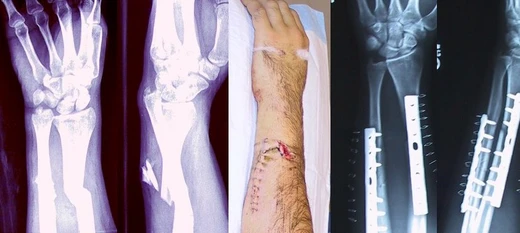
Broken finger
A common bone fracture that usually heals well if treated promptly.

None, Caroline Barton, 2009-07-07 14:45:46 · CC BY-SA 4.0
A broken finger is a fracture in one of the finger bones, and it happens often. You might notice pain, swelling, tenderness, bruising, a crooked look, or trouble moving the finger. Most breaks are simple to treat, but if they aren't handled correctly, they can lead to lasting pain or disability.
The usual cause is a traumatic injury—most commonly from falls, crushing accidents, or sports. Pathological fractures, caused by an infection or tumor, are less common.
**Anatomy**
Finger fractures are named after the bone that breaks. Fingers are numbered 1 through 5, with the thumb as 1. The tip bones (distal phalanges) have three parts: the tuft (very tip), the shaft (middle section), and the base. The other finger bones (middle and proximal phalanges) are divided into base, shaft, and condyle (outer end). Tendons around the joints control movement. On the front and back of each finger run a digital nerve and artery, which can also get injured when the bone breaks.
The AO Foundation/Orthopaedic Trauma Association (AO/OTA) uses a numeric code to describe these fractures without language. It runs: 78 (for a phalanx fracture in the hand), then a number for the finger (thumb=1, little finger=5), then a number for the phalanx (1 to 3, counting outward from the hand), then a number for the location on the bone (1 for the inner end, 3 for the outer, 2 for in between). For example, 78.1.1.1 would indicate a fracture of the thumb's proximal phalanx at the inner end, but note that the standard AO/OTA coding for this specific fracture uses different subsequent digits—always consult the current classification manual for precise codes.
**Fracture Patterns**
If the blow bends the bone sideways, it usually causes a transverse fracture (a break straight across). A force at an angle tends to produce an oblique fracture, and a twisting force often leads to a spiral fracture. Crushing injuries may or may not shatter the bone into multiple pieces, which is called a comminuted fracture.
Fractures inside joints are often caused by jamming the finger—like stubbing your toe but on your hand. If a tendon pulls away the piece of bone it's attached to (an avulsion fracture), that also creates a fracture in the joint.
**Causes**
Putting out a hand to break a fall and landing badly can fracture a finger. Crushing injuries happen when a finger gets shut in a door (most common in child
- annual_incidence_US
- Approximately 0.1% of people (1 in 1,000) per year
Lore & Background
Finger fractures are identified by the bone on which they occur. Fingers are numbered 1 to 5, with 1 being the thumb. The distal finger bones are divided into tuft, shaft, and base; the rest of the finger bones are divided into base, shaft, and condyle. The AO Foundation/Orthopaedic Trauma Association (AO/OTA) classification generates language-neutral numeric codes for describing broken fingers. For example, the code 78.1.1.1 would suggest a fracture of the thumb's proximal phalanx at the inner end, but the standard AO/OTA coding for this specific injury uses different subsequent digits; always verify with the official classification system.
Fracture patterns depend on the force: a sideways blow usually causes a transverse fracture, an angled force an
Reader's Guide
Broken fingers are significant because they are common and, if not treated appropriately, can lead to long-term pain and disability. Treatment ranges from simple splinting or buddy taping to surgery for unstable fractures, fractures extending into a joint, open fractures, or those with damaged tendons or nerves. Complications include decreased range of motion, deformity, post-traumatic osteoarthritis, and infection in open fractures. A Busch fracture, affecting the base of a distal phalanx, can become a mallet finger without adequate treatment. Prognosis is generally good: most heal in 2–8 weeks, with full strength returning in 3–4 months. Pain should steadily decrease within days. Prevention includes protective equipment, safe tool use, safety closers for doors, and fall prevention.
Did You Know?
- Finger fractures affect 12 in 100,000 people per year in the United States.
- The proximal finger bones are the most likely to be broken.
- A Busch fracture is a specific type of finger fracture where the base of a distal phalanx is affected.
- Putting out a hand to break a fall is a common cause of finger fracture.
The Nature of the Injury
A broken finger is, at its core, a fracture — a partial or complete disruption of the structural integrity of one of the small bones of the hand. In milder presentations the bone simply cracks, while in more severe cases it shatters into multiple fragments, a condition clinicians label a comminuted fracture. When the fractured segment pierces through the overlying skin, the injury is classified as an open or compound fracture, which carries a markedly elevated risk of infection compared to a closed fracture where the skin barrier remains intact. Such breaks can result from a high-force impact like a fall or collision, or from minimal trauma when underlying conditions such as osteoporosis, bone cancer, or osteogenesis imperfecta have already compromised the bone's structural strength. In those circumstances the fracture is properly termed a pathologic fracture. Most broken fingers demand prompt medical attention to prevent additional damage to the surrounding soft tissues and to set the stage for proper healing.
Why It Hurts and What You Feel
Although bone tissue itself contains no pain-sensing nerve endings, a broken finger is acutely painful for several interconnected reasons. The periosteum, the membrane enveloping the bone, is densely populated with pain receptors, and its rupture during a fracture triggers an immediate sharp sensation. Ruptured bone marrow leaks into the surrounding soft tissues, generating swelling and a hematoma that press against adjacent structures and produce a deep, throbbing pressure. The body also responds with involuntary muscle spasms as nearby muscles attempt to immobilize the displaced fragments. If the break damages neighboring nerves, blood vessels, or tendons, additional specific symptoms may emerge. Complications can surface at different stages: immediate ones at the moment of injury, early ones within the first few days, and late ones much later. One particularly dangerous late complication is compartment syndrome, in which untreated pressure buildup can ultimately necessitate amputation of the affected limb.
The Body's Remarkable Repair Process
Healing a broken finger follows a well-orchestrated biological sequence. Immediately after the break, the injured bone and surrounding tissues bleed, forming a fracture hematoma between the fragments. The blood coagulates into a clot, and within days new blood vessels grow into this jelly-like matrix. These vessels deliver phagocytes that clear away non-viable tissue, as well as fibroblasts that multiply and produce collagen fibers, gradually replacing the clot with a flexible collagen scaffold. Over time, some of these fibroblasts begin depositing bone matrix, and calcium hydroxyapatite crystals are laid down among the collagen, mineralizing the structure and stiffening it into bone. This initial woven bone becomes visible on X-ray within roughly six weeks in adults and sooner in children. Through a remodeling process it is eventually replaced by stronger lamellar bone. The entire process can extend up to eighteen months, though functional strength typically reaches about eighty percent of normal by three months.
Diagnosis, Classification, and Factors Affecting Recovery
Diagnosing a broken finger usually begins with a thorough medical history and physical examination, followed by radiographic imaging to confirm the break. In complex cases where standard X-rays are insufficient, CT scans or MRI may be employed to assess nearby joints and rule out dislocations. Orthopedic medicine classifies fractures along multiple axes: by mechanism (traumatic versus pathologic), by soft-tissue involvement (closed versus open), and by displacement (non-displaced, translated, angulated, rotated, or shortened). Fractures are further categorized as stable or unstable based on the likelihood of additional shifting. Several lifestyle and nutritional factors influence the healing trajectory. Tobacco smoking is particularly detrimental, as smokers tend to have lower bone density and experience delayed healing. Adequate nutrition, including sufficient calcium intake, supports recovery, while appropriate weight-bearing stress once the bone has stabilized helps rebuild its strength.
Gallery

Frequently Asked Questions
What is a broken finger?
A broken finger is a fracture affecting one of the small bones within a digit, and it is one of the most frequently encountered hand injuries. It can involve any of the five fingers, which are conventionally numbered from the thumb (1) to the little finger (5).
What usually causes a broken finger?
The vast majority of finger fractures result from a direct traumatic event such as a fall onto an outstretched hand, a crushing accident, or a sports-related impact. A smaller subset, called pathological fractures, stem from underlying conditions like an infection or a tumor weakening the bone.
What symptoms should I look for with a broken finger?
Typical signs include localized pain, visible swelling, tenderness to touch, bruising, and sometimes a visibly crooked or deformed digit. You may also notice difficulty gripping or moving the affected finger normally.
How is a broken finger treated and does it heal well?
Most finger fractures are straightforward to manage and heal well when addressed promptly with splinting, immobilization, or, in more complex cases, surgical fixation. However, if the break is misaligned or neglected, it can lead to chronic pain or reduced function in the finger.
How common are broken fingers in the general population?
In the United States, roughly one in every 1,000 people suffers a finger fracture each year, making it a relatively common but highly treatable injury. Because the bones are small and well-supplied with blood, the majority of cases resolve without long-term complications.
More in Bone fractures 1-24
Spotted an error? Know more?
This is a living reference — every entry is fact-audited, and reader corrections feed straight into our audit queue. Suggest an edit · See this site's audit record