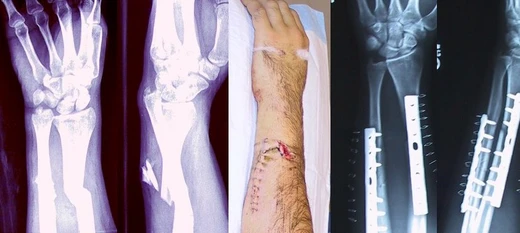
Bone fracture
A break in bone continuity requiring medical attention.

A bone fracture is a medical condition involving a partial or complete break in the continuity of any bone in the body. It may result from high-force impact, stress, or minimal trauma due to underlying diseases that weaken bones, such as osteoporosis or bone cancer. Most fractures require urgent medical attention to prevent further injury.
- field
- Orthopedic medicine
- known_for
- Classification of fractures by mechanism, pattern, displacement, and soft-tissue involvement
- complications
- Compartment syndrome, non-union, malunion
- healing_time
- Bone callus visible on X-ray within 6 weeks in adults; strength 80% of normal by 3 months
- risk_factor
- Smoking lowers bone density and delays healing
Lore & Background
Bone fractures are classified in various ways, including by mechanism (traumatic, pathologic, periprosthetic), soft-tissue involvement (closed or open), displacement, fracture pattern (linear, transverse, oblique, spiral, compression, impacted, avulsion), and fragments (incomplete, complete, comminuted). Open fractures carry a higher risk of infection, with incidence rising from 1-2% in closed fractures to 30% in open fractures. Anatomical classification specifies the body part, such as skull, spine, or limb fractures, with subtypes like Jefferson fracture or Hangman's fracture.
Reader's Guide
The significance of bone fractures lies in their frequency and potential for serious complications. Immediate complications occur at the time of fracture; early complications arise within days; late complications, such as non-union or malunion, may appear long after. Compartment syndrome, if untreated, can require amputation. Healing involves formation of a fracture hematoma, collagen matrix deposition, and mineralization into woven bone, which remodels into lamellar bone over up to 18 months. Smoking hinders healing, while adequate nutrition and weight-bearing stress aid it. Diagnosis relies on history, physical exam, and often radiographic imaging; CT or MRI may be used when plain X-rays are insufficient. The classification system helps guide treatment and prognosis.
Did You Know?
- Bone tissue contains no pain receptors; fracture pain arises from periosteum and endosteum damage, soft tissue edema, and muscle spasms.
- A comminuted fracture involves the bone broken into several fragments.
- Smoking delays bone healing and increases fracture risk due to lower bone density.
- Open fractures have an infection rate up to 30% after internal fixation, compared to 1-2% for closed fractures.
Classification and the Severity Spectrum
The Gustilo-Anderson system is the most widely used method for categorizing open fractures. It grades injuries based on the energy involved, the degree of soft tissue damage, how contaminated the wound is, and how fragmented the bone is. Higher grades correlate with worse clinical outcomes. Infection rates climb dramatically with severity: Grade I fractures see about 1.4% infection, Grade II around 3.6%, Grade IIIA jumps to 22.7%, and the most severe Grade IIIB and IIIC fractures carry infection rates between 10 and 50 percent. Despite its widespread adoption, the system has notable limitations. Interobserver reliability sits at only 50 to 60 percent, meaning two clinicians may grade the same wound differently. Furthermore, the size of the skin opening does not always reflect the true extent of deep tissue damage beneath. Because of this, accurate grading often cannot be confirmed until the patient is in the operating theatre, where the full depth of injury becomes visible.
Mechanisms and Causative Forces
Open fractures most frequently result from high-energy trauma, with road traffic accidents, crush injuries, and falls from height being the leading mechanisms. Direct impacts such as motor vehicle collisions, firearms, and axial loading transfer enormous force to the bone, while indirect mechanisms like torsional twisting or a simple fall from standing can also produce these injuries. The spectrum of causative forces is broad: a direct blow, angular force, torque, or a combination of all three can shatter bone and drive fragments through the skin. Gunshot wounds present a particularly destructive pattern, as high-speed projectiles generate secondary shock waves and cavitation that devastate surrounding tissue far beyond the entry point. Pathological fractures represent a different category entirely, where minor trauma is enough to break bone already weakened by metastatic lesions, bone cysts, or advanced osteoporosis. Fracture-dislocations combine a break with a joint dislocation in a single severe event. Working-age young men face the highest risk, though older individuals with osteoporosis and compromised soft tissue are also vulnerable.
Initial Assessment and Clinical Evaluation
When a patient arrives with a suspected open fracture, the immediate priority is not the bone itself but ruling out any other life-threatening injuries. The Advanced Trauma Life Support protocol guides this initial assessment, ensuring that internal bleeding, airway compromise, or other critical conditions are identified before orthopedic concerns take center stage. Once the patient is stabilized, the affected limb must be fully exposed to uncover any hidden damage. Clinicians carefully document the wound's characteristics, the mechanism of injury, and the energy transferred to the body, all of which inform the severity classification. Neurological and vascular status of the limb are assessed to detect nerve or blood vessel damage that may not be immediately obvious. A high index of suspicion for compartment syndrome must be maintained, particularly in leg and forearm fractures, as this condition can rapidly threaten limb viability. The mechanism of injury also helps estimate the level of contamination, which directly influences the urgency and scope of surgical intervention required.
Surgical Management and Infection Control
The management of open fractures revolves around several core principles: therapeutic irrigation, wound debridement, early wound closure, and bone fixation. All of these interventions share a dual purpose—reducing the risk of deep infection and promoting proper bone healing. Urgent surgical intervention is critical, as delays increase the likelihood of long-term complications including deep infection, vascular compromise, and in the worst cases, complete limb loss. After thorough irrigation of the wound, dry or wet gauze is applied as a temporary dressing. Antibiotic therapy is a cornerstone of treatment; cephalosporins, sometimes combined with aminoglycosides, are typically administered for at least three days to combat bacterial contamination. The Gustilo-Anderson grade directly guides the aggressiveness of treatment and helps clinicians predict the likely clinical trajectory. The tibia is the most commonly fractured bone in these injuries, and the combination of soft tissue destruction with bone fragmentation makes these fractures among the most challenging in orthopedic surgery to manage successfully.
Gallery
Frequently Asked Questions
What is a bone fracture?
A bone fracture is a medical condition in which the structural continuity of a bone is partially or fully disrupted. It can affect any bone in the body and generally requires urgent medical care to prevent additional damage.
What causes a bone fracture?
Fractures typically arise from high-force impacts, repetitive mechanical stress, or even minor trauma when a pre-existing condition like osteoporosis or bone cancer has already compromised bone strength.
How long does a bone fracture take to heal?
In adults, a bone callus usually becomes visible on an X-ray within roughly six weeks, and the affected bone regains about 80 percent of its original strength by the three-month mark.
What complications can a bone fracture lead to?
Serious complications include compartment syndrome, non-union where the bone fails to knit back together, and malunion where the bone heals in a misaligned position.
What risk factors increase the chance of a bone fracture?
Smoking is a well-documented risk factor because it lowers overall bone density and slows the healing process, making fractures both easier to sustain and harder to recover from.
More in Bone fractures 1-24
Spotted an error? Know more?
This is a living reference — every entry is fact-audited, and reader corrections feed straight into our audit queue. Suggest an edit · See this site's audit record