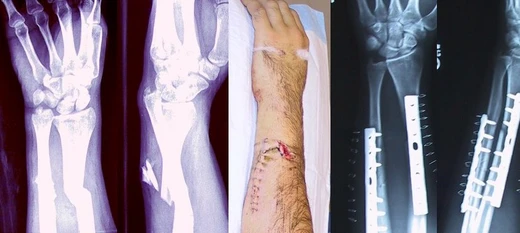
Essex-Lopresti fracture
Fracture of radial head with distal radio-ulnar dislocation.

The Essex-Lopresti fracture involves a break in the radial head of the forearm, combined with a dislocation of the distal radio-ulnar joint and a tear in the thin interosseous membrane that connects the two forearm bones. The condition was first documented by Peter Essex-Lopresti in 1951.
This injury usually results from a fall onto an outstretched hand, known as a FOOSH injury.
Diagnosis can be tricky because initial medical attention often focuses on the radial head fracture, causing the distal radio-ulnar joint injury to be missed. In patients who have experienced high-energy forearm trauma, tenderness at the distal radio-ulnar joint on examination suggests an Essex-Lopresti injury. Plain X-rays reveal the radial head fracture, and a lateral view of the pronated wrist frequently shows dorsal subluxation of the ulna.
Treatment for the radial head fracture typically involves open reduction internal fixation under general anesthesia. The surgeon opens the area, manually realigns the bone fragments, and secures them with titanium pins or plates. If the fracture is too comminuted—meaning the bone is crushed or broken into many pieces—a radial head implant may be used. Removing the radial head should be avoided, as this can lead to proximal migration of the radius over time, causing wrist pain and loss of pronation and supination. Delayed treatment of the radial head fracture also results in proximal migration of the radius. The distal radio-ulnar joint dislocation can be reduced by supinating the forearm, and it may be pinned in place for six weeks to allow the interosseous membrane to heal.
Most healthy individuals recover from this injury within about ten weeks. However, as with many bone fractures, there is always a risk of malunion between the bone fragments.
- field
- Orthopedic surgery
- known_for
- Describing the Essex-Lopresti fracture in 1951
Lore & Background
The injury typically occurs in patients who have fallen on an outstretched hand, known as a FOOSH injury. Diagnosis can be difficult initially because medical attention is usually focused on the radial head injury, leading to the distal radio-ulnar injury being overlooked. Tenderness of the distal radio-ulnar joint suggests an Essex-Lopresti injury in patients who have sustained high energy forearm trauma. Plain radiography shows the radial head fracture, with dorsal subluxation of the ulna often seen on lateral view of the pronated wrist.
Reader's Guide
Management of the Essex-Lopresti fracture involves open reduction internal fixation of the radial head under general anesthesia. If the fracture is too comminuted, a radial head implant can be used. Excision of the radial head should be avoided, as over time this will cause proximal migration of the radius, leading to wrist pain and loss of pronation and supination. Delayed treatment also leads to proximal migration. The distal radio-ulnar joint dislocation can be reduced by supination of the forearm and may be pinned for six weeks to allow healing of the interosseous membrane. Most healthy individuals recover within ten weeks, though malunion between bone fragments is possible.
Did You Know?
- The injury is named after Peter Essex-Lopresti who described it in 1951.
- It typically occurs from a fall on an outstretched hand (FOOSH injury).
- Excision of the radial head should be avoided to prevent proximal migration of the radius.
- The distal radio-ulnar joint dislocation can be reduced by supination of the forearm.
More in Bone fractures 1-24
Spotted an error? Know more?
This is a living reference — every entry is fact-audited, and reader corrections feed straight into our audit queue. Suggest an edit · See this site's audit record