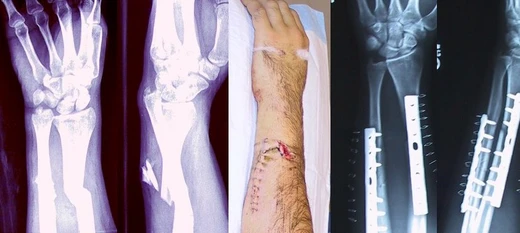
Elbow fracture
Elbow fractures involve one or more bones of the elbow joint.

An elbow fracture is a break in one or more of the bones that make up the elbow joint—specifically the ulna, radius, or humerus. These bones work together like a hinge, allowing the arm to bend, straighten, and rotate. Because the joint is complex, the way the injury happens, how it’s treated, and what complications might arise all depend on which bone is broken. The two most common causes are a direct blow to the elbow or using an outstretched arm to catch yourself during a fall.
**In Adults**
**Distal Humerus:** In healthy, strong bone, a fracture here usually requires a high-impact event. But in weaker, osteoporotic bone, even a simple fall on the ground can cause it. Unless the bone pieces are barely out of place, surgery is typically needed. Surgeons often use two metal plates and screws to hold the bone steady while it heals and to prevent rotation. Possible complications include irritation of the ulnar nerve, abnormal bone growth (heterotopic ossification), or general stiffness in the elbow.
**Radial Head:** These fractures happen when a force pushes the forearm inward (valgus force), either on its own or as part of a more complex dislocation. They are classified by the Mason system: Type I (displaced less than 2 mm, with normal forearm rotation), Type II (displaced more than 2 mm or angled), Type III (shattered and blocking rotation), and Type IV (fracture plus a dislocated elbow). Only Type I fractures are treated without surgery. For more severe cases, a surgeon may either fix the bone with a plate and screws or replace the radial head entirely.
**Olecranon:** The most common causes are falling on an outstretched hand or a direct hit to the bony point of the elbow. Several classification systems exist (Mayo, Colton, Schatzker), but the general rule is that surgery is needed if the bone pieces are separated by more than 2 mm. For elderly patients with low activity demands, non-surgical care may be an option. Surgical methods include open reduction with tension band wiring (TBW) or plate-and-screw fixation. TBW works by turning the tension side of the fracture—where the bone pulls apart when muscles contract—into a compression side, which helps healing. TBW is cheaper, faster, and causes less bleeding, but it often requires a second surgery to remove the hardware. Long-term range of motion is similar between the two methods. Other complications i
- common_causes
- Direct trauma to the elbow joint or bracing a fall with an extended arm
- bones_involved
- Ulna, radius, humerus
- most_common_pediatric_fracture
- Supracondylar humerus fractures
- adult_fracture_types
- Distal humerus, radial head, olecranon, coronoid process, terrible triad
Lore & Background
In adults, distal humerus fractures in young healthy bone require high impact to break, but osteoporotic bone can break with lower energy mechanisms such as ground level falls. Unless minimally displaced, these fractures generally require operative intervention with two plates and screws. Radial head fractures occur from valgus force and are classified by the Mason system; only Type I is treated non-operatively. Olecranon fractures commonly result from a fall on an outstretched hand or direct trauma, and operative management is indicated if displacement exceeds 2 mm; tension band wiring and plate fixation are both used, with no difference in long-term range of motion.
Reader's Guide
Elbow fractures are significant because they affect a complex joint essential for arm movement and daily function. Treatment varies widely by fracture type and patient age, with pediatric fractures often managed differently from adult fractures. Supracondylar humerus fractures are the most common pediatric elbow fracture, typically from a fall on an outstretched arm, and are classified by the Gartland system. Lateral condyle and medial epicondyle fractures are the next most common in children. The terrible triad of the elbow—a combination of radial head fracture, coronoid process fracture, and humeroulnar dislocation—carries high postoperative complication rates including osteoarthritis, persistent instability, and stiffness. Understanding these distinctions helps guide appropriate management and anticipate complications.
Did You Know?
- Supracondylar humerus fractures make up approximately 95% of extension-type pediatric elbow fractures.
- Olecranon fractures with greater than 2 cm displacement generally require operative management.
- The terrible triad of the elbow includes a fracture of the radial head, a fracture of the coronoid process, and a humeroulnar dislocation.
- Medial epicondyle fractures in children are often caused by repeated valgus stress from throwing a baseball.
More in Bone fractures 1-24
Spotted an error? Know more?
This is a living reference — every entry is fact-audited, and reader corrections feed straight into our audit queue. Suggest an edit · See this site's audit record