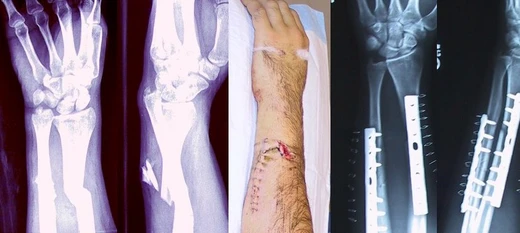
Distal radius fracture
Common wrist fracture often caused by a fall on an outstretched hand.

A distal radius fracture, also known as a wrist fracture, is a break of the part of the radius bone close to the wrist. Symptoms include pain, bruising, and rapid-onset swelling; the ulna bone may also be broken. It is a common injury, representing between 25% and 50% of all broken bones, and is the most common type of fracture seen in children.
- common causes
- Fall on outstretched hand (older people); sports or motor vehicle collision (younger people)
- specific types
- Colles, Smith, Barton, Chauffeur's fractures
- diagnosis
- Suspected based on symptoms, confirmed with X-rays
- treatment
- Casting for six weeks or surgery
- healing time
- A year or two may be required for healing
- complications
- Malunion, nerve injury, post-traumatic arthritis, complex regional pain syndrome
Lore & Background
Complications include malunion, which can lead to residual pain, grip weakness, reduced range of motion, and persistent deformity. Nerve injury, especially of the median nerve presenting as carpal tunnel syndrome, is commonly reported. Tendon injury, most commonly to the extensor pollicis longus, can occur. Complex regional pain syndrome is also associated. Nonunion is rare; almost all fractures heal. Half of nonosteoporotic patients develop post-traumatic arthritis, which can worsen over time.
Reader's Guide
Distal radius fractures are significant due to their high frequency, representing between 25% and 50% of all broken bones, and being the most common fracture in children. They occur most commonly in young males and older females. The injury often results from a fall on an outstretched hand, but can also stem from high-energy trauma. Diagnosis relies on X-rays, with CT scans used for further articular detail. Treatment options—casting or surgery—depend on fracture alignment and joint surface involvement. Complications such as malunion, nerve injury, and post-traumatic arthritis can affect long-term function. The condition highlights the interplay between bone strength, injury mechanism, and patient age. Most children with a buckle wrist fracture experience a broken wrist for life and have an increased chance of re-fracturing the same spot or other adverse effects. A year or two may be required for healing to occur.
Did You Know?
- Distal radius fractures represent between 25% and 50% of all broken bones.
- Buckle fractures in children typically heal completely without long-term issues or an increased risk of re-fracture.
- Half of nonosteoporotic patients will develop post-traumatic arthritis after a distal radius fracture.
- A 'dinner fork' deformity is caused by dorsal displacement and angulation of the distal radius fragment itself, not the carpal bones.
More in Bone fractures 1-24
Spotted an error? Know more?
This is a living reference — every entry is fact-audited, and reader corrections feed straight into our audit queue. Suggest an edit · See this site's audit record