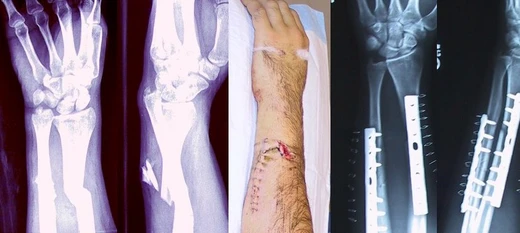
Classification of distal radius fractures
Systems classifying distal radius fractures by pattern and stability.

Classification systems of distal radius fractures aim to aggregate injury patterns that behave predictably, distinguishing conditions with different outcomes or treatment needs. Current systems rely on features such as joint involvement (Frykman), anatomical displacement and method of injury (Melone), and severity (AO/OTA), but individually have limited acceptance and no consensus exists.
- field
- Orthopedic surgery, traumatology
- known_for
- Classification systems for distal radius fractures
- systems_described
- Frykman, Melone, Universal, AO/OTA, Fernandez
Lore & Background
The classification systems for distal radius fractures were developed to help predict outcomes and guide treatment. At one extreme, a stable undisplaced extra-articular fracture can be managed conservatively with cast immobilization; at the other, a displaced intra-articular two-part shear fracture often requires open reduction and internal fixation. Key anatomical features considered include articular incongruity, volar or dorsal tilt, radial inclination, radial length and ulnar variance, comminution, open versus closed injury, associated ulnar styloid fracture, and soft tissue injuries.
Among the systems, the Melone classification breaks fractures into four components—radial styloid, dorsal medial fragment, volar medial fragment, and radial shaft—and comes closest to directing treatment. The Frykman system focuses on articular and ulnar involvement but has little value in directing treatment. The Universal classification is descriptive but also does not direct treatment. The AO/OTA system is widely used with 27 subgroups based on joint involvement and comminution, while the Fernandez system is a simplified, treatment-oriented classification based on injury mechanism.
Reader's Guide
The classification of distal radius fractures remains a contested area in orthopedic practice. The source article notes that current systems individually have limited acceptance and there is no consensus. The Melone system is described as coming closest to directing treatment, while Frykman and Universal classifications are noted as not helping direct treatment. The AO/OTA system is widely used but complex, and the Fernandez system was developed as a simplified alternative. The article emphasizes that an anatomic description of the fracture—including articular incongruity, tilt, radial inclination, length, comminution, and associated injuries—is the easiest way to describe the fracture, determine treatment, and assess stability. Articular incongruity greater than 1 mm places the patient at high risk for post-traumatic arthritis. A dorsal tilt of 0° (11°–12° deviation from normal) causes substantial risk of pain and impaired function, and a residual dorsal tilt of up to 5° is regarded as the maximal acceptable angle after closed reduction. Loss of radial length can lead to ulnar impaction syndrome. The lack of a universally accepted system underscores the ongoing challenge in standardizing fracture management.
Did You Know?
- More than 1 mm of articular incongruity places the patient at high risk for post-traumatic arthritis.
- A dorsal tilt of 0° (11°–12° deviation from normal) causes substantial risk of pain and impaired function.
- Radial length should normally be between 9–12 mm; loss of length can lead to ulnar impaction syndrome.
- The Melone classification breaks distal radius fractures into four components: radial styloid, dorsal medial fragment, volar medial fragment, and radial shaft.
More in Bone fractures 1-24
Spotted an error? Know more?
This is a living reference — every entry is fact-audited, and reader corrections feed straight into our audit queue. Suggest an edit · See this site's audit record