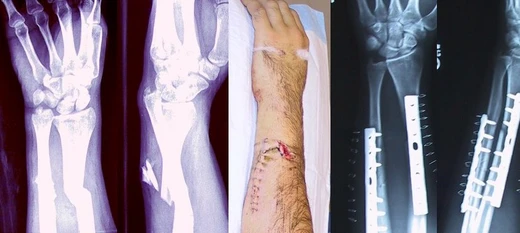
Child bone fracture
Pediatric fractures differ from adult fractures due to growing bones.

A pediatric bone fracture is a crack or break in the bone of someone under 18. Fractures make up about 15% of all injuries in children. Because a child’s bones are still developing, these injuries require special care to avoid interfering with growth.
Bones normally handle everyday forces by flexing and returning to shape. For example, when a teenager jumps off a trampoline and lands on their feet, the bones and connective tissue absorb the impact. But if the force is too strong, the bones cannot support it and fracture.
**Types of fractures**
Children’s bones are softer and have a thicker, stronger periosteum than adult bones, so they tend to bend rather than break completely. The most common fractures in children are incomplete types: greenstick and torus (buckle) fractures.
- **Greenstick fracture:** One side of the bone bends, and the other side partially breaks. The name comes from fresh green wood, which breaks on the outside when bent. The sub-nanostructure of children’s cortical bone may explain this pattern. Unlike adult bone, children’s bone tissue has a low ratio of mature to immature enzymatic cross-links, which could account for greenstick fractures.
- **Torus or buckle fracture:** This occurs at the metaphysis, near the end of the bone. It looks like the torus (base of a pillar) in architecture, with a sharp angle in the cortex instead of a smooth curve. It is caused by impaction, usually from a force along the bone’s long axis—often a fall on an outstretched arm, so it commonly affects the distal radial metaphysis. The word *torus* comes from Latin, meaning swelling or protuberance.
- **Bow fracture:** The bone curves along its length.
- **Hairline fracture:** A thin crack that does not go all the way through the bone.
- **Single fracture:** The bone breaks in only one place.
- **Segmental fracture:** The bone breaks in two or more places.
- **Comminuted fracture:** The bone breaks in more than two places or is crushed into pieces.
- **Corner or bucket-handle fracture:** Fragmentation of the distal end of one or both femurs. The loose piece appears at the bone margins as a dense area parallel to the metaphysis. When the loose piece is wide at the distal end, forming a crescent shape, it is called a bucket-handle fracture. These fractures are characteristic of child abuse.
**Other ways to describe fractures**
- **Closed fracture:**
- field
- Pediatric orthopedics
- known_for
- Distinct fracture types in children (greenstick, torus, bow, hairline, etc.) and higher healing rate due to thicker periosteum
- affected_population
- Children (persons younger than 18)
- prevalence
- About 15% of all injuries in children
- peak_age_for_girls
- 12
- peak_age_for_boys
- 14
- lifetime_fracture_likelihood
- About half of boys and one-fourth of girls
Lore & Background
Child bone fractures are categorized by unique types not commonly seen in adults. Incomplete fractures such as greenstick and torus (buckle) fractures are most common because children's bones are softer and the periosteum is stronger and thicker. A greenstick fracture involves a bend on one side and a partial fracture on the other, named by analogy with fresh wood. Torus fractures occur at metaphyseal locations, typically from a fall on an outstretched arm, causing acute angulation of the cortex. Other types include bow fractures, hairline fractures, single, segmental, comminuted, and corner or bucket-handle fractures—the latter being characteristic of child abuse.
Reader's Guide
The significance of child bone fractures lies in their distinct pathophysiology and treatment considerations. Children's bones heal faster than adults' due to a thicker, stronger periosteum that supplies better oxygen and nutrients, enabling more rapid union and remodeling. However, this thickness can make small displacements difficult to diagnose. Fracture patterns vary by age and sex: the probability increases with age, with girls most commonly fracturing at age 12 and boys at 14; about half of boys and one-fourth of girls experience a fracture during childhood. The wrist is the most likely fracture site. Abuse-related fractures, such as corner or bucket-handle fractures, multiple fractures of varying ages, and rib or vertebral fractures, require careful recognition to prevent further harm. Treatment follows the rule of aligning bones correctly and immobilizing them until healed, with specific approaches depending on severity, whether the fracture is open or closed, and the bone involved.
Did You Know?
- About 15% of all injuries in children are fracture injuries.
- Greenstick fractures are named by analogy with green (fresh) wood, which similarly breaks on the outside when bent.
- Corner or bucket-handle fractures are characteristic of child abuse-related injuries.
- The wrist is the most likely part of the body to be injured in childhood fractures.
More in Bone fractures 1-24
Spotted an error? Know more?
This is a living reference — every entry is fact-audited, and reader corrections feed straight into our audit queue. Suggest an edit · See this site's audit record