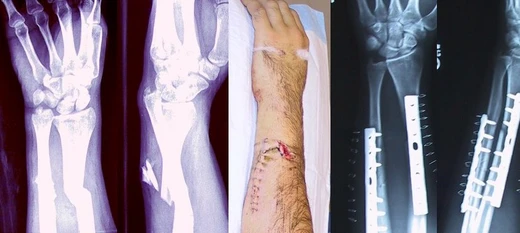
Chalkstick fracture
A transverse bone fracture resembling a broken stick of chalk.

A chalkstick fracture is a break, usually in a long bone, that runs straight across the bone’s length, much like snapping a piece of chalk. In a normal, healthy bone, the collagen within the matrix gives it flexibility, so it tends to break more like a woody stick, with energy dispersing along the bone’s growth rings. Children’s bones are especially pliable and often show a greenstick fracture instead. This particular transverse pattern is most often seen in Paget’s disease of bone and osteopetrosis, and it can also occur when the spine is fused, as in ankylosing spondylitis.
For treatment, people with a stable fracture and no nerve problems may be managed with a nonsurgical orthotic device. Long-term follow-up is necessary to prevent a worsening kyphotic curve. If malalignment syndrome develops, surgery is recommended. Patients who have nerve deficits or an unstable fracture need surgical fixation to relieve pressure on the spinal cord and stabilize the injury. A halo brace is another option for managing cervical fractures.
- type
- bone fracture
- common_in
- Paget's disease of bone, osteopetrosis, ankylosing spondylitis
- typical_location
- long bones, fused spine
- fracture_pattern
- transverse to long axis of bone
- treatment_options
- nonsurgical orthotic management, surgical fixation, halo brace
Lore & Background
A healthy long bone typically breaks like a hard woody stick because collagen in the matrix adds flexibility to the mineral, and energy can run up and down the growth rings of bone. In children, bones may follow a greenstick fracture pattern instead. Chalkstick fractures are particularly common in Paget's disease of bone and osteopetrosis, and are also seen in cases of fused spine as in a patient with ankylosing spondylitis.
Reader's Guide
Chalkstick fractures are significant because they represent a distinct fracture pattern associated with specific bone diseases and conditions that alter bone structure and flexibility. Their transverse nature, like a broken stick of chalk, contrasts with the typical fracture patterns of healthy bone. The condition is especially relevant in Paget's disease, osteopetrosis, and ankylosing spondylitis, where the bone's mechanical properties are compromised. Treatment depends on fracture stability and neurological involvement: stable fractures without neurological defects may be managed nonsurgically with orthotic devices and long-term monitoring to prevent kyphotic deformity, while unstable fractures or those with neurological deficits require surgical fixation to relieve spinal cord compression. A halo brace is another option for cervical fractures. Understanding chalkstick fractures helps guide appropriate clinical management and highlights the importance of monitoring for complications such as malalignment syndrome.
Did You Know?
- Chalkstick fractures are typically transverse to the long axis of the bone.
- They are particularly common in Paget's disease of bone and osteopetrosis.
- They are also seen in cases of fused spine in patients with ankylosing spondylitis.
- Treatment may involve a halo brace for cervical fractures.
More in Bone fractures 1-24
Spotted an error? Know more?
This is a living reference — every entry is fact-audited, and reader corrections feed straight into our audit queue. Suggest an edit · See this site's audit record