Frequently Asked Questions
The most-asked questions about bone fractures.
What exactly is a bone fracture?
A bone fracture is a break or crack in the structural continuity of a bone, ranging from a hairline stress crack to a complete shattering of the shaft. It occurs when the force applied to the bone exceeds its mechanical tolerance.
What are the main types or 'characters' in the fracture world?
The primary categories include greenstick (partial bend), transverse (straight across), oblique (angled), comminuted (shattered into multiple pieces), and stress (tiny micro-cracks from repetitive loading). Each type behaves differently during healing and often requires a different management strategy.
Who are the key specialists you'd encounter when dealing with a fracture?
Emergency physicians and orthopedic surgeons are the primary hands-on specialists, supported by radiologists who interpret the imaging and physical therapists who guide the long recovery. In severe or compound cases, a trauma surgeon or plastic surgeon may also join the team.
Where should a newcomer start to understand bone fractures?
Begin with basic bone anatomy—cortical (dense outer) versus trabecular (spongy inner) tissue—because that architecture determines how a given bone breaks and how it heals. From there, learning the AO/OTA classification system gives you a shared vocabulary for every subsequent discussion.
What is the single most important key fact about fracture healing?
Bones repair themselves through a callus-formation process that typically spans six to twelve weeks in adults, though the timeline shifts with age, fracture location, and local blood supply. The remodeled bone at the healed site can actually become denser and stronger than the original structure.
What are some notable historical milestones in fracture medicine?
Hippocrates described setting and splinting techniques over 2,400 years ago, and the Thomas splint of the 1880s transformed femur-fracture care on Civil War battlefields. Modern breakthroughs include the 1950s introduction of internal fixation plates and the 1980s development of intramedullary nails.
What causes most fractures in everyday life?
Falls account for the vast majority, especially in older adults whose trabecular bone has thinned from osteoporosis. High-impact events such as motor-vehicle collisions and contact-sport collisions tend to produce the more severe comminuted or spiral patterns.
How do you distinguish a fracture from a simple sprain or bruise?
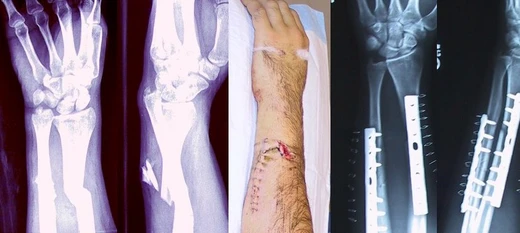
A fracture typically presents with sharp point tenderness, visible deformity, an inability to bear weight, and often crepitus (a grinding sensation) or rapid swelling within hours. Imaging—starting with a plain X-ray and escalating to CT or MRI if needed—confirms the diagnosis.
What are the main treatment approaches for a fracture?
Non-surgical management with a cast, brace, or traction suits stable, well-aligned breaks, while surgical fixation using plates, screws, or intramedullary nails is reserved for displaced, open, or joint-involving fractures. In both paths, early protected motion and progressive weight-bearing drive the best long-term outcomes.
What happens during recovery and how long does it really take?
The initial soft-callus phase lasts roughly two to three weeks, followed by weeks of mineralization and months of bony remodeling that can extend up to a year. Full return to pre-injury activity often outlasts the radiographic 'healed' date, particularly for weight-bearing bones like the femur or tibia.